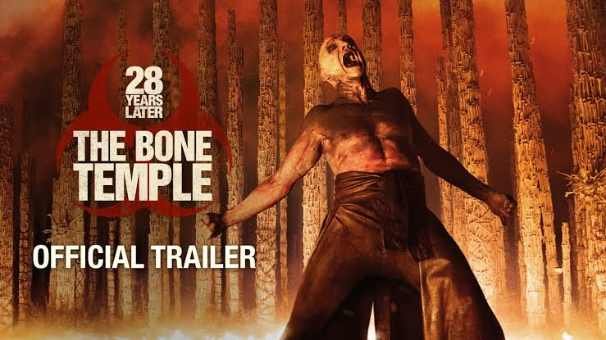
Horror sequels rarely improve on what came before them, but 28 Years Later: The Bone Temple is quickly being recognized as the exception. Following up on the surprise 2025 franchise revival, this sequel has become one of the highest-rated horror releases in years, earning a level of critical and audience agreement that is genuinely rare for the genre.
The Story
28 Years Later: The Bone Temple expands the world first created by Danny Boyle and Alex Garland, but director Nia DaCosta takes that world in bold new directions. The story continues with Spike, played by Alfie Williams, whose encounter with the cult-like leader Sir Jimmy Crystal, played by Jack O’Connell, becomes a nightmare he cannot escape. Meanwhile, Dr. Ian Kelson, played by Ralph Fiennes, bonds with an infected individual named Samson in an attempt to determine whether a cure is possible. The film’s official summary makes clear that in this chapter of the story, the infected are no longer the only threat to survival — the cruelty of fellow survivors proves just as dangerous, if not more so.
Ratings Breakdown: A Franchise Record-Breaker
What sets The Bone Temple apart from most horror sequels is just how consistently strong its ratings have been, both from critics and general audiences.
Critic Score: The film debuted with a Certified Fresh score in the low-to-mid 90s on Rotten Tomatoes, based on well over 300 reviews — a remarkable number that made it the highest-rated film in the entire franchise at the time of release. For context, that score comfortably surpassed the original 28 Years Later’s rating, as well as the scores for both 28 Days Later and 28 Weeks Later, the two films that started the franchise decades earlier.
Audience Score: Just as impressive, the audience Popcornmeter score landed in the high 80s based on well over a thousand verified ratings, a strong number that shows genuine alignment between what critics and everyday moviegoers think of the film. This matters because the previous entry in the franchise was notably more divisive — audiences were left baffled by some of its final narrative choices, creating a noticeable gap between critical praise and audience reaction. The Bone Temple closes that gap almost entirely, with critics and audiences largely in agreement about the film’s quality.
This alignment is one of the most talked-about aspects of the film’s reception. Horror sequels frequently struggle to satisfy both camps simultaneously, since critics often reward artistic risk-taking that general audiences find alienating, while crowd-pleasing sequels can feel formulaic to critics. The Bone Temple manages to thread that needle successfully.
What Critics Are Saying
The critics’ consensus for the film describes it as a direct continuation that increases the gore while deepening the sense of dread, praising Nia DaCosta’s unsettling direction alongside standout performances from Ralph Fiennes and Jack O’Connell. Multiple reviewers have singled out these two performances as representing opposing sides of a larger thematic struggle about survival, faith, and what it means to hold onto humanity in a world that has been unraveling for nearly three decades.
One widely cited review from Total Film called the movie “muscular, visceral, and deeply satisfying,” describing it as by far the wildest and weirdest entry into the franchise’s ongoing zombie saga. A review from Mashable praised DaCosta for growing the saga “with sensational daring and depth,” concluding that the film succeeds simultaneously as a sequel, as a zombie movie, and as a horror film — a rare triple achievement that the reviewer credited with the film’s “gorgeous” visual style and unexpected narrative twists.
Variety’s review praised the film as bold, mind-bending work that finally satisfies horror fans’ craving for “a zombie movie with brains,” while other critics have highlighted the way the film explores deep thematic questions about faith and nihilism within its post-apocalyptic setting, rather than relying purely on shock value or gore for its impact.
Not every critic was uniformly positive — some reviews described the film as “part satisfying triumph, part missed opportunity,” noting that its ambitions occasionally create tonal friction. But even mixed reviews tended to praise specific elements, particularly the central performances and DaCosta’s directorial choices, suggesting that even critics with reservations found plenty to admire.
What Audiences Are Saying
Audience reaction has closely tracked the critical response, with viewers praising the film’s willingness to lean into absurdity and dark humor without undercutting its emotional stakes. One widely shared fan reaction described the film as “hard to look at” and simultaneously “hard to look away from,” calling it a mad, visceral mood piece with a surprising amount of humanity buried underneath its brutal exterior.
This combination of visceral horror and genuine emotional depth is a recurring theme in audience discussion. Many viewers have noted that despite the film’s increased gore compared to its predecessor, it never feels gratuitous, because the violence is consistently tied to larger questions about what survivors are willing to do — and become — in order to stay alive.
How The Bone Temple Compares to the Rest of the Franchise
The 28 Days/Weeks/Years Later franchise has a long and somewhat uneven history when it comes to critical reception. The original 2002 film, 28 Days Later, was well received, while its 2007 sequel, 28 Weeks Later, scored noticeably lower with critics. The franchise’s 2025 revival, simply titled 28 Years Later, improved on that reception significantly but still generated some audience division around its ending.
The Bone Temple breaks that pattern entirely, setting a new high-water mark for the franchise with critics while also becoming the first entry to earn strong, consistent audience approval to match. That achievement is especially notable given that this installment was directed by Nia DaCosta rather than Danny Boyle, who helmed both the original film and its 2025 revival. Alex Garland, however, continued as writer across the new trilogy, providing some creative continuity even as directing duties shifted.
DaCosta, previously known for the acclaimed film Hedda, brought her own distinct sensibility to the material, and critics have widely credited her direction as one of the biggest reasons the film succeeds. Her ability to balance psychological depth with visceral horror set-pieces has been repeatedly highlighted as a major step forward for the franchise.
Standout Elements Reviewers Keep Mentioning
Several specific elements of the film come up again and again across reviews. The performances from Ralph Fiennes and Jack O’Connell are almost universally praised, with critics describing them as representing two fundamentally different philosophical responses to a collapsing world — one rooted in scientific hope, the other in nihilistic control. Their dynamic, even though the characters rarely share scenes directly, has been cited as giving the film its thematic backbone.
The film’s visual style has also drawn consistent praise, described by multiple critics as gorgeous and rich with visual splendor, despite — or perhaps because of — its unflinching depiction of violence and decay. This combination of beauty and brutality appears to be one of the film’s defining stylistic signatures, and it’s a big part of why so many reviews describe the film as simultaneously difficult to watch and impossible to look away from.
Why This Matters for the Franchise’s Future
The 28 Years Later films were conceived from the start as a new trilogy, meaning The Bone Temple is not the final chapter in this particular story. Its record-breaking reception gives the franchise significant momentum heading into its next installment, and critics have already begun speculating about how the next film might build on the thematic groundwork laid here regarding faith, nihilism, and the terrifying difference between the infected and ordinary human cruelty.
Given how divisive the previous film’s ending was among audiences, The Bone Temple’s ability to win back both critics and general viewers is a significant win for the franchise’s creative direction going forward, and it suggests the trilogy’s remaining chapter has a lot of goodwill to build on.
Should You Watch 28 Years Later: The Bone Temple?
For horror fans, this is close to a must-watch. It’s rare for a franchise sequel — particularly its third or fourth entry — to earn the highest ratings in the series’ history, and even rarer for that critical success to be matched so closely by general audience approval. Whether you’re a longtime fan of the franchise or a horror fan simply looking for one of the best-reviewed genre films of the year, The Bone Temple delivers on nearly every front: strong performances, striking visuals, and a story willing to ask bigger questions than a typical zombie sequel usually bothers with.
Where to Watch
28 Years Later: The Bone Temple is currently playing in theaters, and given its franchise-best reception, it is considered one of the essential theatrical horror experiences of 2026. Horror fans looking to avoid spoilers from the film’s numerous discussed twists should catch it in a theater setting sooner rather than later.
Themes That Set This Sequel Apart
Beyond the visceral scares, much of the critical conversation around The Bone Temple centers on its thematic ambition. One review pointed to a closing line in the film that echoes a famous historical warning about the dangers of forgetting the past, arguing that despite the story’s bleak setting, the film ultimately offers a way out of pure nihilism rather than wallowing in it. This kind of thematic layering is unusual for the genre, and it’s a big part of why reviewers have described the film as a “zombie movie with brains” rather than simply another entry in an oversaturated genre.
Critics have also pointed to the film’s structure — following two very different characters whose worldviews collide with the same collapsing society — as a smart way of dramatizing a larger argument about hope versus control. Dr. Kelson’s search for a cure represents a fundamentally optimistic response to catastrophe, while Sir Jimmy Crystal’s cult-like rule over his followers represents the opposite: an attempt to impose order through fear rather than genuine hope. That contrast gives the film’s horror set-pieces a philosophical weight that elevates them above simple shock value.
A Franchise Finding Its Voice Under New Direction
Perhaps the most surprising element of The Bone Temple’s success is how well it works despite the change in director. Franchises often stumble when a signature filmmaker like Danny Boyle steps back, but critics have widely credited Nia DaCosta with not just maintaining the quality of the series but actively pushing it into bolder, stranger territory. Her background directing the acclaimed film Hedda seems to have translated well into a genre setting, bringing a level of psychological nuance to the horror that many reviewers say was missing from earlier, more straightforward entries in the franchise.
This bodes well for whoever eventually directs the trilogy’s next chapter, since it suggests the 28 Years Later universe can thrive under different creative visions as long as the emotional and thematic core — Alex Garland’s writing — remains consistent throughout.
Final Verdict
28 Years Later: The Bone Temple stands as one of the best-reviewed horror films of 2026, combining franchise-best critical scores with strong audience approval — a rare double achievement for any horror sequel, let alone one this far into an established series.